
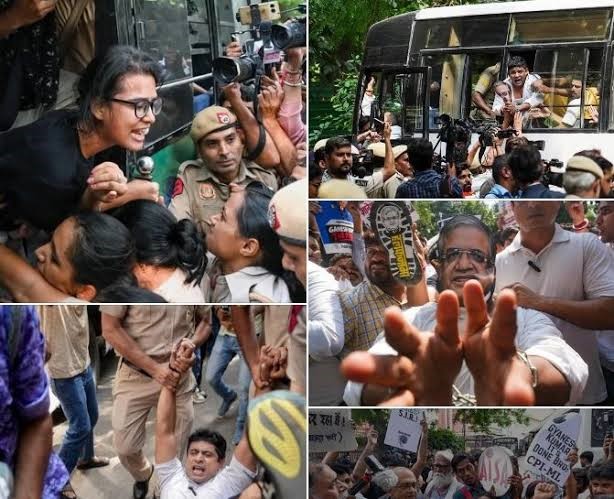
The demonstrations that erupted across New Delhi on October 10 were not born in a vacuum. Spurred by deep-seated fears of systematic disenfranchisement, thousands of protesters, joined by various political formations, converged on key intersections chanting slogans demanding electoral accountability. Their target: an opaque SIR process that resulted in arbitrary deletions, missing names, and anomalous shifts in voter registries.
Electoral rolls are not mere bureaucratic ledgers; they are the holy grail of universal adult suffrage. When administrative errors or deliberate omissions threaten a citizen’s right to vote, the legitimacy of the entire representative structure is compromised. The Election Commission of India (ECI), constitutionally mandated to be an impregnable fortress of impartiality, has instead found itself embroiled in allegations of executive compliance. By stonewalling legitimate queries and dismissing systemic discrepancies as routine anomalies, the ECI has transformed a technical administrative process into an existential crisis of democratic credibility.
Police Action and Press Freedom
As the protests swelled, the state’s knee-jerk reflex was to securitise political dissent. Reports of aggressive police interventions, barricades, and physical force against demonstrators quickly flooded news outlets particularly the Independent journalists . Peaceful political dissent was routinely treated as a law-and-order menace, stripping citizens of their constitutional right to assemble and air grievances.
Crucially, this iron-fisted approach extended directly to the Fourth Estate. Journalists attempting to independently document police actions, detentions, and the scale of the protests faced obstruction, intimidation, and physical assaults. A journalist’s duty is neither to endorse the protesters nor to act as an arm of the administration; it is to bear witness. When reporters are harassed or blocked from scrutinizing the ECI or police lines, democracy suffers a direct blow. A government confident in its mandate and structural legitimacy should welcome, not fear, uncomfortable questions. Coercion in place of answers is the hallmark of insecurity.
Arrests and the Absurdity of Power
The high-handedness of the administration was further underscored by the targeted arrests and judicial custody of political figures, including leaders of the Cockroach Janta Party and student activists like Neha Bora of AISA. Among the most glaring abuses of state machinery was the reported use of peaceful actions—such as waving the national flag at Jantar Mantar—as pretextual grounds for detention.
To criminalise the tri-color in the heart of the national capital is an inversion of democratic symbolism. When carrying the national emblem becomes a punishable offense under the guise of maintaining public order, the state reveals a profound paranoia regarding peaceful expression. It sends a chilling message: conformity is compulsory, and dissent will be penalized under any legal contortion available.
Opposition Momentum
Amid this escalating pressure, the protests have served as a vital crucible for opposition unity. For too long, fragmented opposition parties struggled to mount a cohesive counter-narrative against the BJP-led government. However, the existential threat posed by alleged voter-list manipulation has galvanized political coordination, moving the debate past routine partisan skirmishes into a broader national campaign for electoral transparency.
Within this emerging front, Congress leader Rahul Gandhi has stepped into a distinctly more assertive leadership role. By relentlessly spotlighting institutional capture and framing electoral integrity as the ultimate frontline for the republic, Gandhi has helped provide the movement with strategic clarity. His public interventions and calls for systemic accountability have not only energized disparate opposition ranks but have also forced the ruling establishment to confront an opposition that is increasingly unified, vocal, and anchored in constitutional defense.
The Constitutional Stakes
Ultimately, this standoff lays bare the fragility of India’s foundational safeguards. Universal adult suffrage, free and fair elections, freedom of speech, peaceful assembly, and institutional independence are not independent pillars; they stand or fall together.
Legitimate administrative verification of voter rolls must never become a cloak for politically motivated exclusion. Without transparent grievance-redress mechanisms and an independent Election Commission willing to subject itself to public scrutiny, the promise of representative democracy turns into an empty ritual.
Nemesis
When the foundational registers of a republic are called into question, the response of a democratic state should be definitive, transparent, and anchored in dialogue. Yet, looking out across the barricades of New Delhi since October 10, 2026, the picture is chillingly different. Batons, arbitrary detentions, and a heavy cloak of administrative silence have greeted citizens, political workers, and reporters alike. At the heart of this confrontation lies the contentious Special Intensive Revision (SIR) of electoral rolls and surging public anger demanding the removal of Chief Election Commissioner Gyanesh Kumar over widespread allegations of bungling and manipulation in the voter-list revision process.
When citizens question the integrity of voter lists, opposition parties demand accountability, and journalists attempt to document the confrontation, does the state respond with transparency and dialogue—or with coercion and silence? The answer echoing from the streets of the capital points unmistakably to the latter.
The confrontation playing out in New Delhi is a defining test for the Indian republic. When an administration chooses silence, batons, and arrests over dialogue and transparency, it signals a deep erosion of democratic norms. Electoral integrity, independent journalism, and the right to dissent are the oxygen of a free society—choke one, and the entire system gasps for air.
As the dust settles over the capital’s barricades, a stark question remains for those entrusted with safeguarding the world’s largest democracy: How long can a government rule by fiat before the foundational contract between the citizen and the state is irreparably broken?