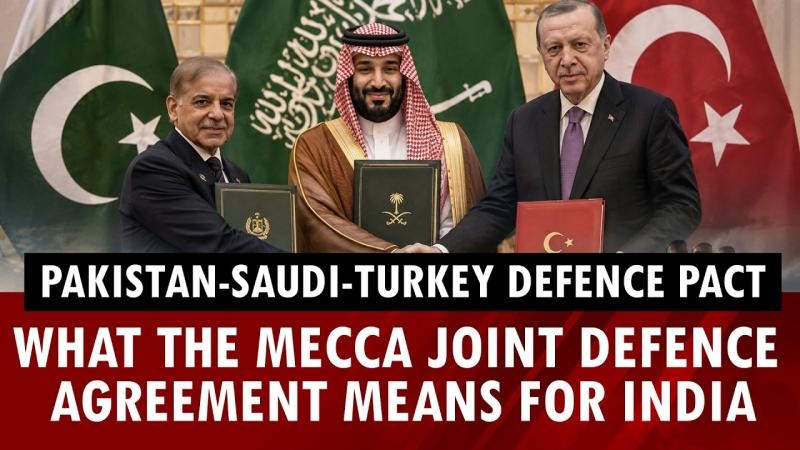
It’s been eleven days since three men stood in Islam’s holiest city and signed something that’s quietly rewriting the Middle East’s security map. On August 7, Saudi Crown Prince Mohammed bin Salman, Turkish President Recep Tayyip Erdogan and Pakistani Prime Minister Shehbaz Sharif put their names to the Mecca Joint Defence Agreement. The core promise fits in one line: an attack on any one of the three is an attack on all three.
That’s an Article 5 clause. NATO’s clause. Except this one binds the Arab world’s richest state, NATO’s second-largest army, and the only nuclear-armed country in the Muslim world — together good for 1.4 million active troops, over 3,400 aircraft and 6,000 tanks. And eleven days on, the early noise has settled into something clearer: this wasn’t a one-off photo-op. Countries are already lining up to ask what it would take to join.
Meanwhile Trump tweeting on his Truth Social network welcomed the pact calling it a “big, bold, and important first step”. “Very happy to see that Saudi Arabia, Turkey, and Pakistan have recently, and finally, signed the Mecca Joint Defence Agreement. It shows how the Middle East is coming together, and how countries will finally be able to defend themselves in a more meaningful way.” “Congratulations to the Great Leadership of the three Nations mentioned. THIS IS A BIG, BOLD, AND IMPORTANT FIRST STEP – WOW,” Trump wrote.
Why this, why now
Look at the last six months and the timing explains itself. Since February, a wider war involving Iran has kept the Gulf on edge — missiles and drones hitting energy infrastructure Saudi Arabia has struggled to fully shield. Israel’s reach has kept expanding too, including a strike on Doha last year that rattled even the capitals that usually stay quiet. Through all of it, Washington’s presence has felt less like a guarantee and more like a maybe.
That’s really the story. Not some grand anti-Iran coalition — Riyadh has been careful to say the pact “does not represent any intention to build a military axis,” and isn’t linked to any arms race. It’s a hedge. Saudi Arabia looked at a region on fire and an ally that wasn’t fully showing up, and built its own safety net instead.
What each side brings
The pact works because the three genuinely complement each other. Saudi money and energy leverage. Turkish combat experience and a defence industry already exporting drones to Riyadh — Turkey’s biggest export order to date, back in 2023. And Pakistan, which brings troops, doctrine, and the one thing nobody else at the table has: the bomb.
To be fair to the cautious voices — Chatham House and others have pointed out the agreement doesn’t actually extend Pakistan’s nuclear umbrella over Saudi Arabia or Turkey. That doctrine has aimed squarely at India for decades, and rewriting it overnight would be a genuinely massive shift Islamabad hasn’t signalled. But deterrence doesn’t run only on what’s written down. It runs on what the other side assumes. Now that Pakistani generals sit in joint planning rooms in Riyadh, Tehran — and eventually Delhi — has to assume a little more than it did a month ago.
Who’s circling, who’s holding back
The most interesting news of the last week isn’t the pact itself, it’s who hasn’t joined it. Turkey’s foreign minister Hakan Fidan has openly said the alliance shouldn’t stay limited to three countries, and named Egypt as the natural next member. Egypt hasn’t said yes. Reports suggest Riyadh itself is uneasy about Cairo’s growing closeness to the UAE, and Egypt has its own reasons to hang back — deep financial ties to Abu Dhabi, a defence pact with the UAE, and old links with Greece and Cyprus that would get complicated fast. There’s also a quieter thread: Egypt and India built a genuine partnership on non-alignment going back to the Cold War, and Cairo doesn’t seem eager to be pulled into a bloc that could put that at odds with Tehran, Israel or Delhi.
Meanwhile others are moving faster. Kuwait widened its own defence pact with Pakistan just last month. Bahrain and Jordan have shown interest. Qatar’s name keeps coming up. What started as three flags in Mecca is turning into a waiting room.
Where does that leave India?
New Delhi’s response so far has been the diplomatic equivalent of a raised eyebrow — “closely following,” “studying the implications” — much like when the original bilateral Saudi-Pakistan pact was signed last September. That caution is fair. But the scenario actually worth watching isn’t a Saudi-Iran flashpoint, it’s what happens the next time India strikes inside Pakistan after a terror attack. Legal experts say that wouldn’t technically trigger the clause. Maybe. But legal fine print tends to blur in an actual crisis, and Delhi now has to price in — even as a long shot — that the next Balakot draws statements, if not more, from Ankara and Riyadh too.
The bigger picture
Step back and Mecca is really about one thing: a Muslim-majority security bloc that isn’t asking Washington for permission, because it’s stopped expecting Washington to show up. Add BRICS expansion, the Gulf’s growing comfort with Moscow and Beijing, and Turkey’s decade-long drift from the transatlantic fold, and the signal is consistent — middle powers aren’t waiting anymore. They’re building, and apparently recruiting.
The unipolar moment didn’t end with a bang. It ended quietly, with three men in a mosque city signing a defence pact, fairly certain nobody in Washington could stop them.
Eleven days later, nobody has.